If you're lucky enough to live to 100, the years between 50 & 75 are your third quarter. That segment in life could be the waning of your physically agile years, so it's a good idea to stay active. It's also a good time to challenge your brain to keep things limber up there - by mastering something new. We decided to go sailing, and this is a chronicle of our journey.

7/24/13

US Coast Guard Auxiliary Classes: Navigation (paper & GPS)

Two phones, the same compass app, in the same location, with different readings.
Last weekend, I took a Navigation course at the US Coast Guard Auxiliary in Oxnard, CA. Up until a few months ago, I had no idea the Coast Guard offered affordable and comprehensive boating courses to the public.  For two days, my brain was marinated in latitudes & longitudes, fathoms, soundings, range bearings, magnetic vs true compass readings, GPS, Radar and plotting courses with a parallel rule, dividers and a pencil on paper, etc. It was excellent. Challenging, for sure, especially for my math-phobic gray-matter, but I learned so much.

Electronic chart (Nobeltec) showing the shipping lanes in Santa Barbara Channel
Taking a class on navigation has equipped me with a full course back up plan, and a side dish of confidence.  If GPS goes out while we're floating somewhere in the sea in a fog bank, due to electrical failure, a lightening strike, military activity, or this summer's predicted solar flare GPS failures, I can figure out where we are, and where we need to be, and how to get there with a chart, a rule, a compass & a pencil.  That peace of mind is a good thing.  (I don't know how to use a sextant yet, but just you wait.) 


The first weekend in June, Don and I took a USCG course on Boating Skills and Seamanship, which included ID of buoy systems, ATONs, understanding light & horn communication from other vessels, and rules & regulations on the water, etc.  That course was also excellent, and the quality of the curriculum and instruction was confirmed when I saw many of the same people we met in that first class attending the Navigation course.  


Buoy Rest Stop for Sea Lions
Each of the Coast Guard classes cost us $40 apiece, which pays for the in-depth book on the course subject, so if two people take the course and share one book, it's $40. (And if you insure your vessel with BoatUS, they'll give you a 10% discount refund check on your insurance for completing the course.)  The instructors are members of the Coast Guard Auxiliary, and they come from a variety of backgrounds with a broad range of interests and specialties.  If you're new-ish to boating, have a look at taking a course through your local Coast Guard Auxiliary. Most of the other attendees in the Navigation class were seasoned boaters, and they all agreed that they learned a lot and it was well-worth the time. Since the US Coast Guard has been on the water since 1790,  I like to think about the breadth & depth of knowledge they have. That's an abundant well to draw from.

The book used in the Navigation Course - it's excellent.

The instructors and fellow attendees shared useful resources on a variety of boating topics.... here are a few:

USHarbors

National Weather Service Brochures, Publications and Pamphlets

Annual Boating Accident Statistics

Free download; USCG ATONs (Aids to Navigation) Manual, including buoy markers, beacons & symbols

Details on compliance for a safe vessel, and complimentary vessel safety checks from USCG

s/v Florian headed back to Ventura CA 


7/18/13

Pursuit of a Dry Bilge - Part II (& a blueberry mojito cocktail)

Searching for the source of unpleasant oder; we found it.
After the last post in our ongoing endeavor to dry the bilge, we were feeling smug for halting the weeping water tanks. I grinned to see a 1/2 cup of water, instead of a gallon or two in the bilge. But, as everyone with boats knows, there's always another surprise waiting around the corner. Our beautiful sailboat started to smell. The kind of stink that made my nostrils constrict without any help from my pinched fingers. 

Looking under the galley sole at the Pink Water. Ick.
By the 2nd weekend, we found pinky/orange water in the bilge, with stuff growing in it. Since we aren't on the boat during the week, organic materials have 5 days to putrefy. It was a bad-smell-party all week. We searched high and low for a source, and found standing pink water under the engine compartment. There was enough to flow forward over the top of our glassed-in holding tank, and into the bilge. Our first suspicion was the stuffing box.  But it wasn't leaking. A relief, but what else could it be?  The hot water heater? Nope; this was not fresh water. A leak in the hull? Why is it pink? What would you guess?

Siphoning stinky-pink water from under the engine
How do you get under there?

Boat Yoga; climbing into the engine compartment with hoses.
Everything on a boat is better as a two person job.
The source of the pinky-orange tint;
a socket wrench submerged under the engine.
 We removed all the smelly water, and rinsed the hull sides and hoses with fresh water and mold inhibitor before we had to leave for the work-week. The following weekend, she smelled a little better, but not much. We worked on other projects, searched for leaks & found none. Just before heading home, while running the engine, I climbed into the aft end of the engine compartment with a flashlight, and found a stream of salt water coming from the lazarette locker, and running down the hull to the void under the prop shaft. The area we had just emptied was full of water again.

The transom is on the left; water appeared to be pouring out
of a hose juncture on the Espar Heat exhaust.
Out in the cockpit, we took turns hanging upside down in the lazarette with a flashlight to trace the source back, and found water pouring from the Espar Heater exhaust hose (see above). We shut everything down and went home to start the work week, totally perplexed, because there is *no water* in the exhaust system on an Espar Heater, and it was brand new. :(  What the heck.

Standing over the lazarette, wondering how to get in
without getting stuck, or breaking things mounted inside.
Note: if you do this alone, always have your cell phone on you. :)
 I took a mid-week trip out to the boat, with a gopro video camera mounted on a pole to get close ups in an area we couldn't physically climb into, and the footage revealed the problem. We had used our new Espar Heater a few times on chilly evenings, and the exhaust hose was installed too close to the Vetus Waterlift Muffler. The hot exhaust hose melted a small hole in the top of the plastic muffler gooseneck & "glued" the insulation cloth to the muffler.  Sea water was escaping the muffler through a hole, filling the insulation cloth around the Espar hose, and flowing into the lazarette. It *looked like* the Espar exhaust hose was leaking water, but the source was the engine's muffler system. The area where the Espar hose & the muffler made contact was behind the Vetus gooseneck where we couldn't see it. Of course.

Looking up from the base of the lazarette at the contact point between the Espar & Vetus
The culprit.
A new Vetus muffler was installed, and angled farther to starboard, and the Espar Exhaust was re-wrapped with new insulation and bowed farther to port. They broke up, but the relationship is amicable. :) All of this was done by someone we hired who is a lot smaller than we are. I watched him fold, twist and shimmy into the lazarette with awe. Now that I know how it's done, I can climb in there too. (See images here.) I'm not sure how well I'll do if we're bouncing around on the Pacific, but at least I know I can scrunch enough to squeeze in and get access to the systems in there. If you have an Espar Heater (we love ours), be sure to give the exhaust hose lots of room. :)


A hard day's work deserves rewards. This is a Blueberry Mojito reward.

Blueberries, lime juice, & mint leaves - the aroma is all about summertime
This delicious recipe is from a wonderful blog called The Novice Chef.

Here's what you'll need:

1 cup of fresh blueberries (& extra for garnish)
4 oz of clear rum
10 fresh mint leaves
2 tsp of sugar
Juice from 2 limes, and extra wedges for garnish
6 oz club soda
ice

Use a blender to puree all but a few of the blueberries, and set aside.

Add 8 mint leaves and the sugar to a cocktail shaker (or a bowl if you have none). Use a muddler (or the end of a wooden spoon) to muddle the mint and sugar together.  
Add the lime juice, and the rum, and the pureed blueberries; shake vigorously in the cocktail shaker (or stir in the bowl).
Pour ice and club soda into tall glasses and then pour the rum & blueberry/lime/mint mixture into the glasses. Stir gently and garnish with lime wedges and a mint leaf. Serve immediately.
These go down smooth and lip-smackingly easy, so enjoy them carefully. ;)

Preparing for sunset on s/v Forian


Our favorite bar book, by the founder of the 

London Academy of Bartending - 
Douglas Ankrah: Shaken and Stirred.

6/13/13

In Pursuit of a Dry Bilge: Kracor Water Tanks (& a cocktail recipe)

My step-dad TC and Don on Heiress (Cape Dory 31)
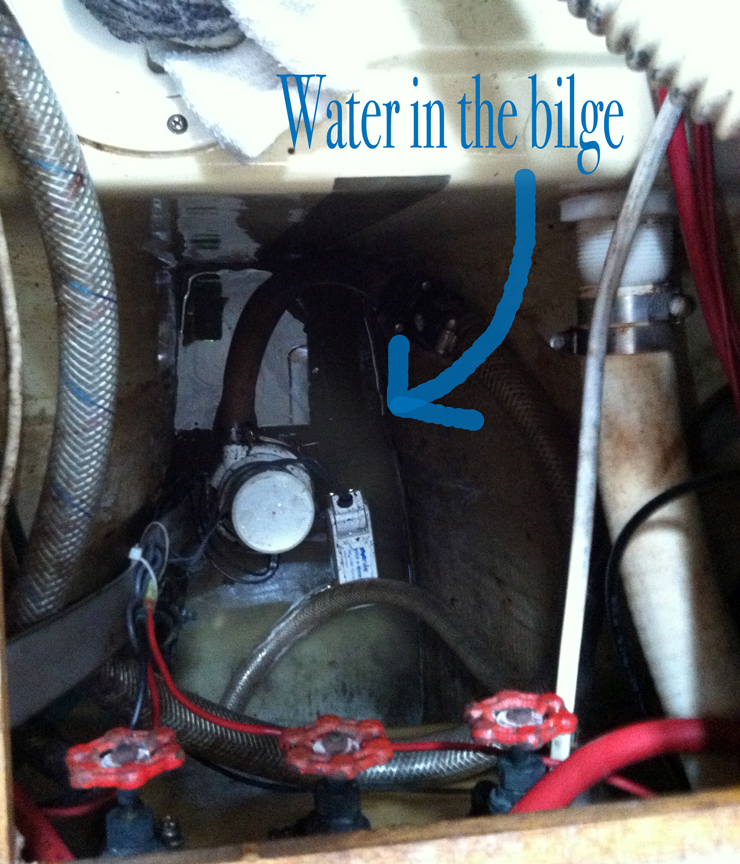
For my non-boaty friends, a bilge is like a miniature basement; a compartment on a boat that sits in the lowest area - under the sole (floor) - below the waterline. It's purpose is to collect & contain liquids - everything from waves-over-the-boat sea water, to leaking engine oil & diesel, etc.  A wet bilge is normal, so automatic bilge pumps are installed to keep the levels manageable.

A little water in the bilge is normal and acceptable.
But I'd prefer ours (above) to be dry & dusty.
The contents of bilges can be informative, because other than wet marine environment condensation running down the interior walls of your hull, the other stuff boaters find in bilges is often evidence of some looming project (a split in the sanitation hoses, a leaking oil seal, corroded gas tank, weeping through-hulls, etc.) I'll go on record and say it; we want a dry bilge. Our salty, seasoned, sailing friends shake their heads at this seemingly naive & futile goal. But determination works for salmon swimming upstream, and we're determined.  If you're not into bilge water source diagnostics (and if you're not a boater, I don't blame you), scroll to the bottom of this post for a groovy cocktail recipe that has nothing whatsoever to do with bilges or boats. And thanks for stopping in.

Mopping pooled water around the caps of the tank under the nav berth
 After finding tiny rivers of wetness snaking down the sides of the bilge from three directions, we traced those little water maps back to the sources and found pools on top of all three fresh water tanks after recently filling them.  We reduced the level of the water in the tanks by running the faucet, and took the caps off to have a look at their sealing abilities.

One of the existing caps on our Kracor water tanks
One of the existing Kracor water tank cap gaskets
They were probably original to the boat (17 years old), and looked like they needed to be retired. We jotted down the serial number and manufacturer of the tanks, and called Kracor to ask about replacement caps. Steve at Kracor took our call, and he was kind, helpful and very knowledgeable. He deduced the make and model of our boat by the serial number of the starboard tank, because they were custom made for Cape Dory and Robinhood boats. Then he informed us that the openings and caps, which are actually called clean out covers, are manufactured to be splash proof, but *not* water proof, so the tanks should not be filled to maximum capacity. Now we know. (And I wonder; how does that work when we're heeled over?)

New cap & gaskets arrived in the mail; big difference!
 When I explained that I wanted to order replacements for our old and slippery "splash proof clean out covers",  he said we'd save money by ordering them directly from the supplier Kracor orders them from. (How cool is that?) And the company - Claire's Marine Outfitters - recently opened an Ebay store, to make online ordering easier. So, for $14 each, we got three new caps for our water tanks. Yahoo!

Much better = not leaking. :)
 Boaters are all too familiar with the concept of Scope Creep; when your original plan for a project stretches and grows to take more time, more supplies and more money.  Well, of course, once we got the tanks open, and saw the slime on the original caps, we used flash lights to explore the interior of the fresh water tanks.  Too Many Floaties.  :(  So, we began - in earnest - researching all the different ways and products used to clean fresh water tanks. But I'll save that for another post.

Canadian Smoke Jumper (think: pancakes at a campfire)
I found this drink - a Canadian Smoke Jumper - online here, and since Don a) loves Laphroaig, b) loves all things maple, and c) is a fire fighter, we had to make it. The recipe calls for equal parts:

Laphroaig Single Malt Scotch Whiskey
Crown Royal Maple Finished Whiskey
Simple Syrup

We erred on the side of sweet-caution, and reduced the simple syrup by half, and will probably reduce it further in the next round. If you like smokey, peaty scotch, and maple scent & flavor - like pancakes by a campfire, you might like this drink.  Enjoy!

Thanks for stopping by!

6/11/13

One Year as Boat Owners (& a Force 10 Sea Kettle Grill for sale)

Pacific Ocean skies above Florian's sails off the coast of Ventura
We took delivery of s/vFlorian - our Robinhood 36 - one year ago. I keep a folder of all boat related images on iphoto as a visual documentation/log of our projects, and as a reminder of our progress. In a year, we've taken a little over 2500 boat pictures.
This is how happy boat owners look (photo by our wonderous friend, J.H.)
Now, to be fair, I'm trigger happy on the shutter, and I like to document *everything*. This comes from being so visually oriented that I'm pretty much lost if I don't have visual cues in life (things like math & numeric time tables make me cry). But being turbo-girl on the camera is a benefit  I think, because when I scroll through the photos, and jot down the projects we've accomplished on the boat in the past twelve months, it's a loooong list, and I'm pretty sure I would have forgotten half of them without this pictorial diary.  I have many blog posts to write, to share all the repairs, upgrades and retrofits we've tackled, and I hope to write more this summer.  And in the meantime, we've got a Force10 kettle grill for sale. (See pics below.) Did I give you whiplash with that subject change? Ooops. Sorry. :)

This globe kettle was in the lazarette on our boat, and after a little cleaning, it's ready to grill.

Force10 still makes marine stoves, but I don't think they make kettle grills any more.

The stem of the kettle grill, to attach to your pulpit rail.

Propane connection on the grill (propane tanks are not included in this offering)

The manual to the Force 10 Sea Kettle Maine Barbecue

The hot plate and grill inside the kettle. It works fine, or use it for parts.

Hinges for the cover work great, as does the vent.
 If you're interested in buying this little sea kettle, send me an email at bdelpesco   at  mac  dot  com. I've got a box to ship it pretty much anywhere, and if you're in the area of Los Angeles or Ventura, you can just pick it up. Grill season is here. :) (Sold)

Sunset in Ventura, CA

3/15/13

Winter & Spring Sailboat Projects

Birds will ensure frequent visits to your boat over the California
winter, because you'll want to scrub all the crap they splatter
on the deck & sail covers before it petrifies in the sun.
If you're really unlucky, you'll have to remove their nests
from under your dodger. (Not us, but our slip neighbors; what a mess.)
We've spent weekends working on the boat here and there over the winter, but not as frequently as we did in the Fall and Summer. When it's raining, windy and cold, we'd rather stay home, and work on the plenty of other things that need our attention.

Try not to drop your key card on a windy day.
Especially if it might fly out of your hand before
you even get the gate to your dock open.
But if you must, be sure to drop it at low tide
 so you can crawl precariously down
the slippery rocks to go retrieve it.
We've accomplished a decent pile of projects, which we'll write about soon. The assortment included water-tank clean out, a new stereo, an overhaul of the propane system & new tanks, a bilge mystery and a leak in the Vetus Water Exhaust system.  When we sleuthed the cause of water-where-it-shouldn't-be (the exhaust), we both tried to fold, twist & squeeze into the lazarette to access it, but we failed. We called on a professional to help. A small-ish professional.

Jose, showing how it's done. Getting to the exhaust to replace the Vetus.
After watching the Amazing Jose (abt 5'5") fold himself
just right, and twist & scrunch ever so slowly to get into our lazarette,
I felt sure I could fold enough too (I'm 5'11").  It wasn't easy, but I did it.
 The mistake in my effusively enthused accomplishment (the pic above was snapped as I was coming back out) was that Don thought for about 2.5 seconds, and announced that from now on, if we need anything else in the lazarette worked on, I'm the Go-To-Gal for the job. Durnitt.

Little puddles of rain water coming in the anchor
hawsepipe and  settling at the base of the mast.
 In our search for a dry bilge, some of our next projects include a re-do of the hawsepipe, a new mast boot, re-bedding cleat screws on the foredeck where we've got water coming down the thread of the screws - and then, of course, lots of mold abatement. :) More on that later too. I know, I bet you can't wait.

But even with the rainy chill, and the list of projects,
we did find some unseasonably beautiful days
here and there, which gave us an excuse to take breaks
 and sprawl in the cockpit in the sunshine
with a cold beer and an ear-to-ear grin.
We are SO glad Spring is here!


1/1/13

Happy New Year (and a little carpet install)

Winter sunset in the slip on s/v Florian
Florian has a nice teak & holly sole (floor)
The previous owners of our sweet little boat took very good care of her. The sole (floor) is almost 17 years old, but it looks great, with just a few scratches here and there. We thought it might be wise to protect it with carpet, and give our bare feet a surface to land on that's less slippery when wet, and less chilly during the winter. Boat carpeting is spendy, so we went looking for an alternative.
We used butcher paper to make a template on the floor
 I use black butcher paper to seal the back of my art when I frame it, so I have a big roll of the stuff on a dispenser in my studio. I cut a length off, brought it to the boat, and we made a template of the shape and size we needed to cover just the center-line of the teak, with holes for the drop-down dining table legs to lock into their little recessed collars.

Shopping the remnant carpet store
I found a carpet remnant manufactured for school floors (water proof and tough) for about $40.
Laying our template over the remnant
We flipped the carpet remnant, and flipped our template, and traced the shape on the back of the carpet webbing.

Don uses a straight edge and a knife to cut the remnant
With cardboard and a big cutting surface underneath, Don cut the carpet to size.
Cutting non-slip to lay under the carpet
I bought a roll of non-slip carpet backing for about $9. and we cut & placed it between the sole (floor) and the carpet to eliminate any slipping, and to protect the wood from the course surface of the carpet backing.

The floor is prettier than the carpet we've
covered it with, but it's protected now

Here's a nice, old fashioned Winter cocktail - the Applejack Rabbit
Fill a cocktail shaker half way with cracked ice
Add four shots of your favorite Calvados (apple brandy)
Squeeze the juice of one small lemon into the shaker
Add two teaspoons of real maple syrup (or more if you like sweet)
Cap & shake mightily.
Strain the drink into chilled glasses and top with a thin apple wedge.
Put your feet up, take a deep breath and enjoy this dandy little drink.
Happy New Year!